
If you are considering an SAP DevOps approach, you are likely thinking about how to integrate automated SAP tools to accelerate delivery and reduce risk, fast tracking the journey,
This focus on integration hasn’t always been the norm. More than a decade ago, Rev-Trac integrated with another SAP third-party tool to help organizations manage change across complex SAP landscapes.
At the time, the market was not ready. Simplifying SAP change management was the focus, not building integrated SAP DevOps pipelines.
Today, however with the spotlight on SAP DevOps, integration has become a buzzword. Organizations are no longer asking if they should integrate ALM and DevOps tools but how to do in a way that supports speed without increasing risk.
Why SAP DevOps requires a unified toolchain
A major challenge for large IT teams building tightly integrated SAP DevOps backends is the number of siloed stakeholders in the delivery process.
- Test managers focus on testing and validation
- Development team leads aim to deliver more code, faster
- Operations teams are responsible for protecting their production environment
While these groups have different priorities, they share a common goal: to automate their area of responsibility while reducing the risk of unscheduled downtime.
Without a unified approach, competing objectives cloud decisions about what tools to invest in, even though all teams are contributing to the same SAP value stream.
The role of decentralized authorization and centralized information
Organizations that succeed in improving end-to-end delivery to support SAP DevOps initiatives often share one characteristic: they decentralize authorization while centralizing information.
This approach:
- Allows users to work independently in the tools best suited to their roles
- Ensures all SAP change data is accessible from a central location
- Enables faster decision making without sacrificing governance
In practice, this means developers, testers, and operations teams continue working with their respective systems, while stakeholders who need oversight can access accurate real-time change from one place.
Fast-tracking SAP DevOps with orchestration
In our experience, conversations with customers and prospects alike, focus on DevOps toolchains and the need to ensure the right tool is called at the right time, every time.
This is where orchestration becomes critical.
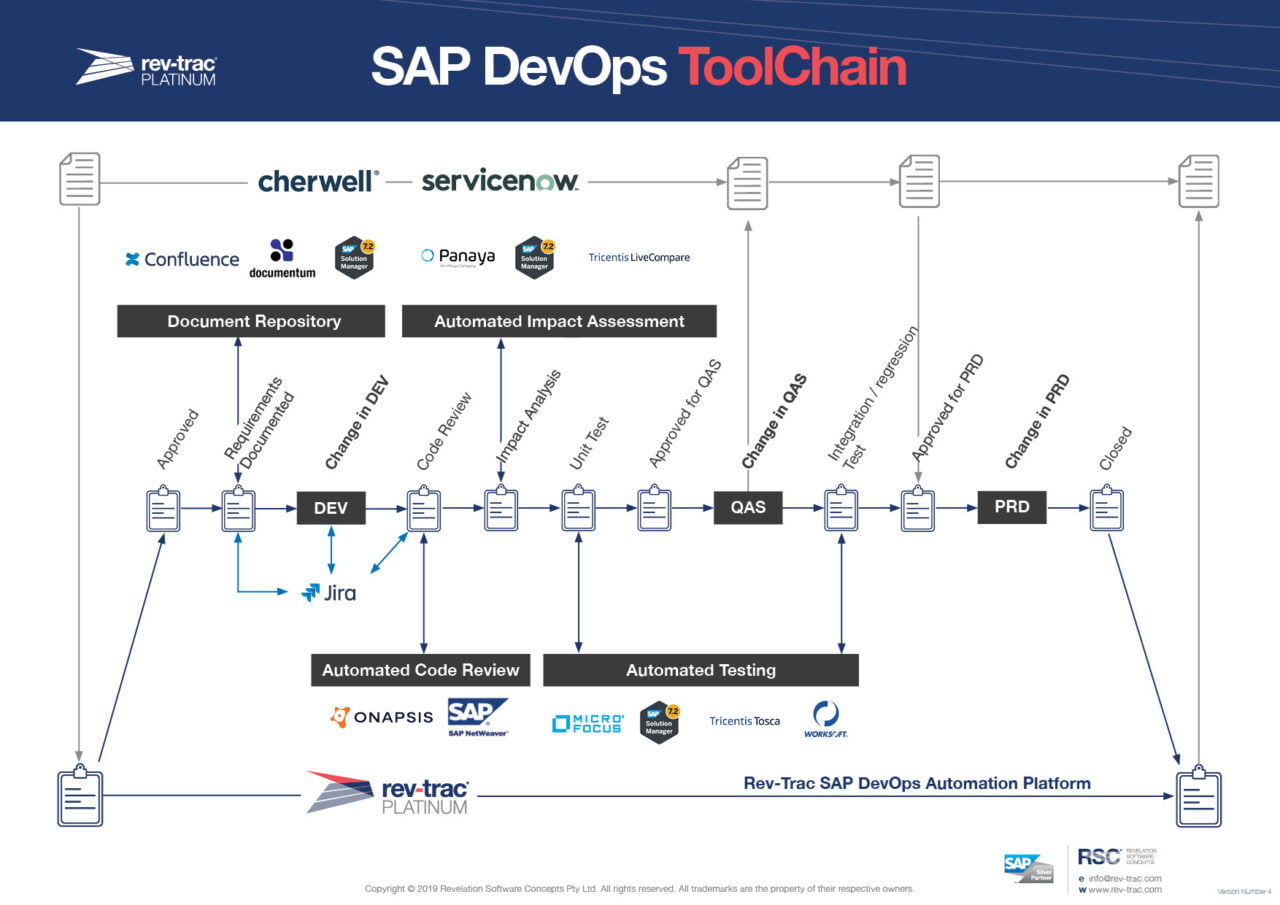
Rev-Trac acts an SAP DevOps orchestration platform, integrating with third-party ALM, ITSM and DevOps tools, and incorporating them into highly flexible end-to-end workflows to meet DevOps initiatives.
These orchestration capabilities have been available to Rev-Trac customers for over a decade, positioning the platform as:
- A central point of control triggering automations related to SAP change
- An automation engine that orchestrates rapid, low-risk delivery
- A system of record for SAP change
Where should SAP information live?
A critical decision for organizations adopting SAP DevOps is where to centralise change information.
For most Rev-Trac customers, the choice is between Rev-Trac or an ITSM tool.
The answer typically depends on the ratio of SAP development vs non-SAP development.
Organization with predominantly SAP change often find Rev-Trac a more natural location for centralization. Thos with a higher volume of non-SAP development often centralize in ITSM tools.
Rev-Trac supports both models seamlessly:
- Acting as a pure orchestration engine when ITSM is the system of record
- Acting as an auditable SAP change management and orchestration platform when Rev-Trac is the system of record
How decentralized authorization and centralized information can work in practice
Case 1: ITSM-led authorization (Rev-Trac is the system of record)
- An ITSM request automatically creates the Rev-Trac Request
- Developers collate specification documentation and SAP transports in Rev-Trac (centralized information)
- All authorizations for the build of the change are managed in Rev-Trac
- Final deployment approvals are granted in the ITSM tool (decentralized authorization)
Case 2: Test-driven authorization (Rev-Trac is the system of record)
- Rev-Trac automatically triggers a test automation tool to perform QA testing
- The test tool executes the relevant test scripts and returns results
- Results are attached to the Rev-trac Request
- Approval is driven by test result (decentralized authorization)
- Rev-Trac captures the result for full audit history of change (centralized information)
These approaches to centralizing information and decentralizing authorization can be applied across any section of the SAP DevOps toolchain.
Frequently Asked Questions (FAQ)
What is an SAP DevOps toolchain?
An SAP DevOps toolchain is an integrated set of tools that support planning, development, testing, approval, and deployment of SAP change in a coordinated, automated way.
Why is orchestration important for SAP DevOps?
Orchestration ensures the correct tools are triggered in the right sequence, reducing manual effort, eliminating bottlenecks, and lowering production risk.
Does Rev-Trac replace ITSM or testing tools?
No. Rev-Trac integrates with ITSM and test automation tools, acting as an orchestration engine while allowing each tool to remain fit for purpose.
Can Rev-Trac act as the system of record?
Yes. Rev-Trac can act either as a system of record for SAP change or the orchestration layer when another tool is the central point for storing data.
How does this approach reduce SAP delivery risk?
Centralizing information and decentralizing authorization combined with enforcing workflows gives organizations visibility and control without slowing delivery.
Accelerate your SAP DevOps journey
A successful SAP DevOps strategy depends on integration, orchestration and a separation between where work is authorized and where information is stored.
If you would like to learn more about SAP DevOps and how Rev-Trac can help your organization achieve its delivery objectives, contact one of our SAP change management experts.
If you have any questions or want more information about SAP DevOps and how Rev-Trac can help your organization reach its objectives, please contact one of our SAP change management experts.