




Summary
SAP Cloud ALM is the strategic successor to Solution Manager (SolMan) and is designed to support mode Cloud-centric ERP. It will become the foundation of SAP’s future ALM strategy. But organizations moving from SolMan and ChaRM still need to consider how change and hybrid environments will be managed during the transition to Cloud ERP.
Understanding the move from SolMan to SAP Cloud ALM
SAP Cloud ALM is positioned as the next-generation application lifecycle management (ALM) platform for SAP customers transitioning to Cloud-centric ERP.
While the end of support for SolMan is well documented, understanding how SAP Cloud ALM differs from SolMan is a key step in planning for a successful transition.
This raises an important question for SAP users:
What should organizations consider when planning their migration from SolMan to SAP Cloud ALM?
At Rev-Trac, this is a question we spend a lot of time on. We actively support customers transitioning to Cloud ERP and SAP Cloud ALM as it continues to evolve, particularly in areas such replacing SolMan’s ChaRM capabilities. It’s a shift we understand well and help customers navigate with confidence.
The case for Cloud
For customers with a Cloud-centric plan, SAP Cloud ALM is the natural first choice. As SAP’s modern ALM platform, it’s well-supported by SAP, has a rich future roadmap, and is included in any Cloud ERP contract, guaranteeing a level of service. All of this makes it an appealing solution for Cloud landscapes.
Most organizations, especially the 80% of new SAP customers adopting Cloud ERP as their first SAP deployment, will find SAP Cloud ALM a complete and effective solution for application lifecycle management.
Beyond ChaRM
Armed with this information, it would be easy to wrap the discussion here. Cloud ERP is the next generation of SAP, and SAP Cloud ALM manages it sufficiently for most users.
However, many organizations with complex SAP environments usually have high-levels of customization, integrated 3rd-party tools, or multiple landscapes often with separate tracks for different projects. In these scenarios, SAP Cloud ALM becomes part of a broader ALM ecosystem rather than a standalone solution. Here are some key areas to think about as you approach your own migration from Solution Manager to SAP Cloud ALM:
- How long is the transition plan between the start of your Cloud ERP migration project and the final decommissioning of the last on-premises system? The transition period likely requires hybrid infrastructure management for project/transition landscapes.
- Do you use complex transport routing? Customers using global templates or XLD will still require ChaRM for this functionality.
- Do you orchestrate release workflows involving more than BTP and ABAP, or require external integration to solutions such as JIRA, Jenkins, Azure DevOps, or other software development tools?
- Are you supporting secure environments with air-gap production requirements?
- Do you require transport repackaging, detailed transport analysis, or specialized import sequencing?
- Does your release process include bespoke release workflows, digital signatures, or audit and compliance requirements common in highly regulated GxP environments?
For some customers, SAP Cloud ALM is a complete and effective solution, particularly for Cloud-first and less complex SAP landscapes. However, these are considerations that existing SAP customers with advanced requirements or industry-specific constraints should evaluate when planning their migration to SAP Cloud ALM. If you have requirements (from the list above), they can still be met with SAP Cloud ALM, but you need to add some integrations to support continuity during the transition period and beyond.
The sky opens up
At Rev-Trac, we are big fans of SAP Cloud ALM as a new standard ALM solution for SAP. We’ve been building integrations with Cloud ALM to best support our customers during the Cloud ERP transition.
SAP have bought out their change and deployment management strategy, and it clearly shows what they are building with SAP Cloud ALM as well as where they will be relying on partners to deliver certain functionality. Some of those integrations will have retirement dates soon enough as SAP Cloud ALM continues to mature. And others, like comprehensive GxP support, are likely to remain the specialty of solutions like Rev-Trac for a while.
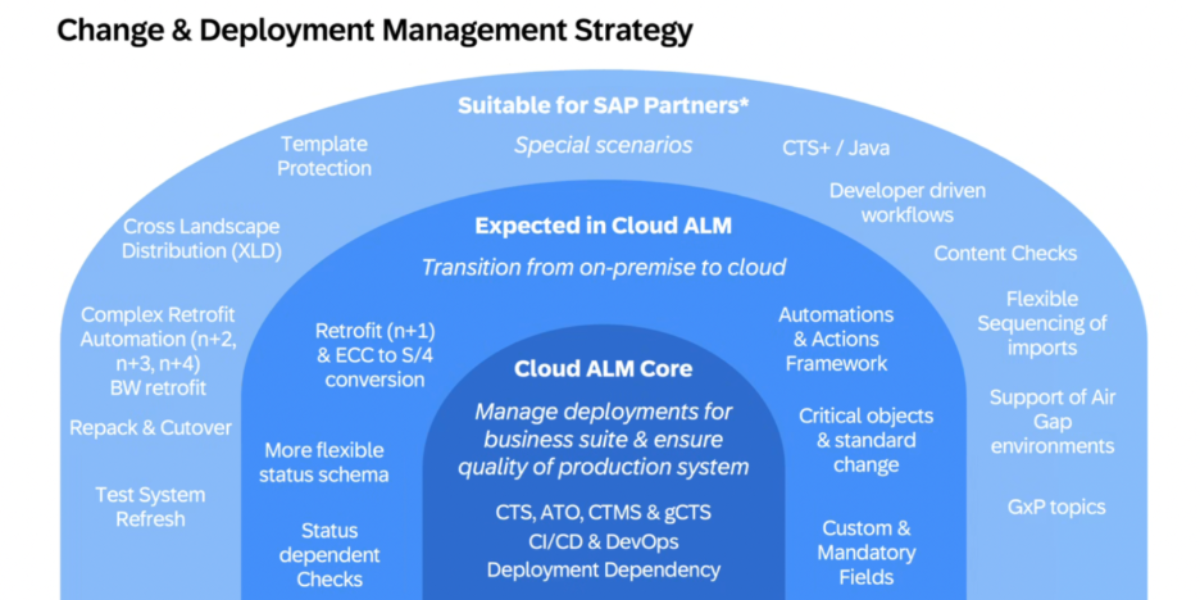
For customers electing an integrated approach combining SAP Cloud ALM and Rev-Trac, there’s some additional benefits as well:
- Automatic detection of technical release errors, eliminating the need for functional testing to detect transport and technical handling errors
Detecting and preventing accidental overwrites and missing dependencies
Automatically identifying critical or sensitive object modifications
- Immediately alerting developers of object conflicts as they arise, preventing unintentional parallel development or painful code merge events
- Ensuring an SAP Cloud ALM feature implementation is free from technical errors before it progresses to testing
- Concurrent management of change across ECC, S/4HANA, Cloud ERP, BTP and non-SAP from a single point of control
- Integration with enterprise service management solutions including ServiceNow
- Support global templates, XLD and N+n at any level of scale and complexity, including transport between ECC and S/4HANA
- Support for air-gapped production environments
- Transport repackaging, detailed transport analysis, specialized import sequencing and other technical analysis and enforcement
- Customizable release workflows, including digital signatures, delegation, enforcement, segregation of duties, audit and compliance reporting at any level of detail
- And specific requirements for complex SAP landscapes (listed above)
FAQ: SAP Cloud ALM, SolMan, and ChaRM
What is SAP Cloud ALM?
SAP Cloud ALM is SAP’s next-generation application lifecycle management platform which is designed primarily for managing Cloud-based ERP environments.
Does SAP Cloud ALM replace Solution Manager?
SAP Cloud ALM is the strategic successor to Solution Manager, but it introduces a different architecture and feature set. Organizations transitioning to SolMan must consider how current change management processes will evolve.
Is SAP Cloud ALM a direct replacement for ChaRM?
For many Cloud-centric deployments, SAP Cloud ALM can manage application lifecycles effectively. However, organizations with complex SAP environments, advanced transport management requirements, or operating in highly regulated environments can extend Cloud ALM with complementary solutions.
How does SAP Cloud ALM support hybrid SAP landscapes?
SAP Cloud ALM can integrate with Cloud-first and less complex SAP landscapes. In more complex environments, particularly hybrid SAP landscapes during the transition to Cloud ERP, organizations can integrate additional tools with SAP Cloud ALM to enhance change governance, automation, and cross-system coordination.
Avoiding the storm
So, proceed to SAP Cloud ALM with confidence. However, if you have complex SAP environments with specific requirements, schedule a call with a Rev-Trac expert. We understand the challenges of migration well, and we are happy to share our expertise with ensuring the success of your SolMan to Cloud ALM migration project.