The SAP ecosystem has a tradition of partnerships: Vertex for tax, OpenText for document and invoice management, Vistex for pricing and rebates, BlackLine for financial close. Each one extended SAP into a discipline with its own depth, its own regulators, and its own specialists.
Such vendor partnerships are time-honored, bringing together adjacent technologies to solve larger operational challenges for complex businesses with unique needs.
Today we explore a recently announced partnership with that same level of impact, focused on SAP compliance and risk in operations, and specifically the intersection of SAP operations and SAP change management. Anyone who has built a Basis operating model around Solution Manager, LaMa, ChaRM or Focused Run knows how much ground those tools covered.
The problem Avantra and Rev-Trac together address is one nearly every large SAP customer faces, and until now had no complete answer: maintaining continuous compliance in SAP change and operations during transformation, transition and the adoption of Cloud ALM, Cloud ERP and hybrid operations.
The transition from Solution Manager to Cloud ALM is real, beneficial and complicated
SAP’s application lifecycle management layer is modernizing. The natural center of the modernization is Cloud ALM: purpose-built for cloud-resident deployments, aligned to how SAP designed Cloud ERP to run, and the right destination for much of the SAP installed base. For a customer running close to standard in a cloud-first estate, Cloud ALM is a well-scoped and capable answer.
The complication is not the destination, but rather the length of the road.
More than half of large SAP customers are still running ECC. A large enterprise carrying dozens of landscapes, decades of accumulated customization, integration into half the business, and a regulator on the other side of every change does not migrate in a quarter. Such an estate migrates pragmatically, incrementally, system by system, over a period often measured in years. That is not laggard behavior. It is the reality of moving mission-critical systems responsibly.
Which means hybrid operation is not a waypoint on the way to a target state. For this segment of SAP enterprises, it can be the working state for a year or years, depending on the size and complexity of the total migration. Meanwhile Landscape Management has already retired, and the mainstream maintenance clock on Solution Manager is running.
Solution Manager coverage
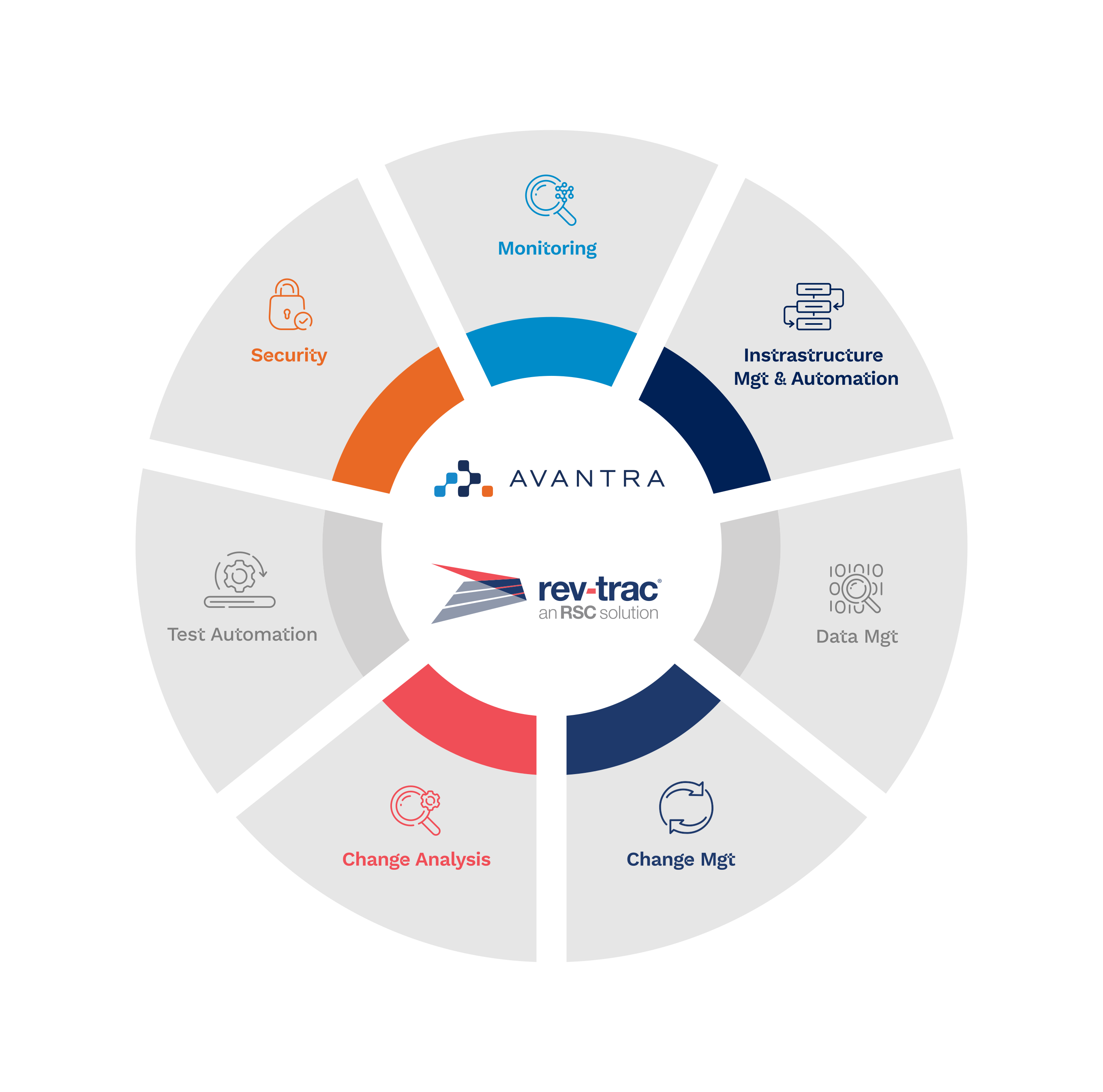
Monitoring, infrastructure management and automation, security, change management, change analysis, test automation and data management were significant parts of the total offering. Solution Manager and LaMa, sometimes adding Focused Run, touched on all of it.
In a cloud-resident world, several of those spokes fold into the platform itself. Hyperscalers and Cloud ERP absorb many technical operations details formerly customer concerns to manage directly, and Cloud ALM covers critical lifecycle functions in that architecture. That is real simplification, and customers heading to a clean, cloud-centric estate will feel it.
In a hybrid estate, those spokes don’t disappear. They stay exactly where they were: on the customer’s side of the line, for systems running for years to come, under the same audit obligations they’ve always carried. The customer now holds them without the tooling that used to help run them.
SAP built the ALM integration door, deliberately
SAP designed Cloud ALM with extension points, and it did so on purpose. No single vendor’s standard scope can absorb the full variance of the world’s most complex ERP estates, and SAP has been consistent in encouraging and enabling the ecosystem to service those unique requirements.
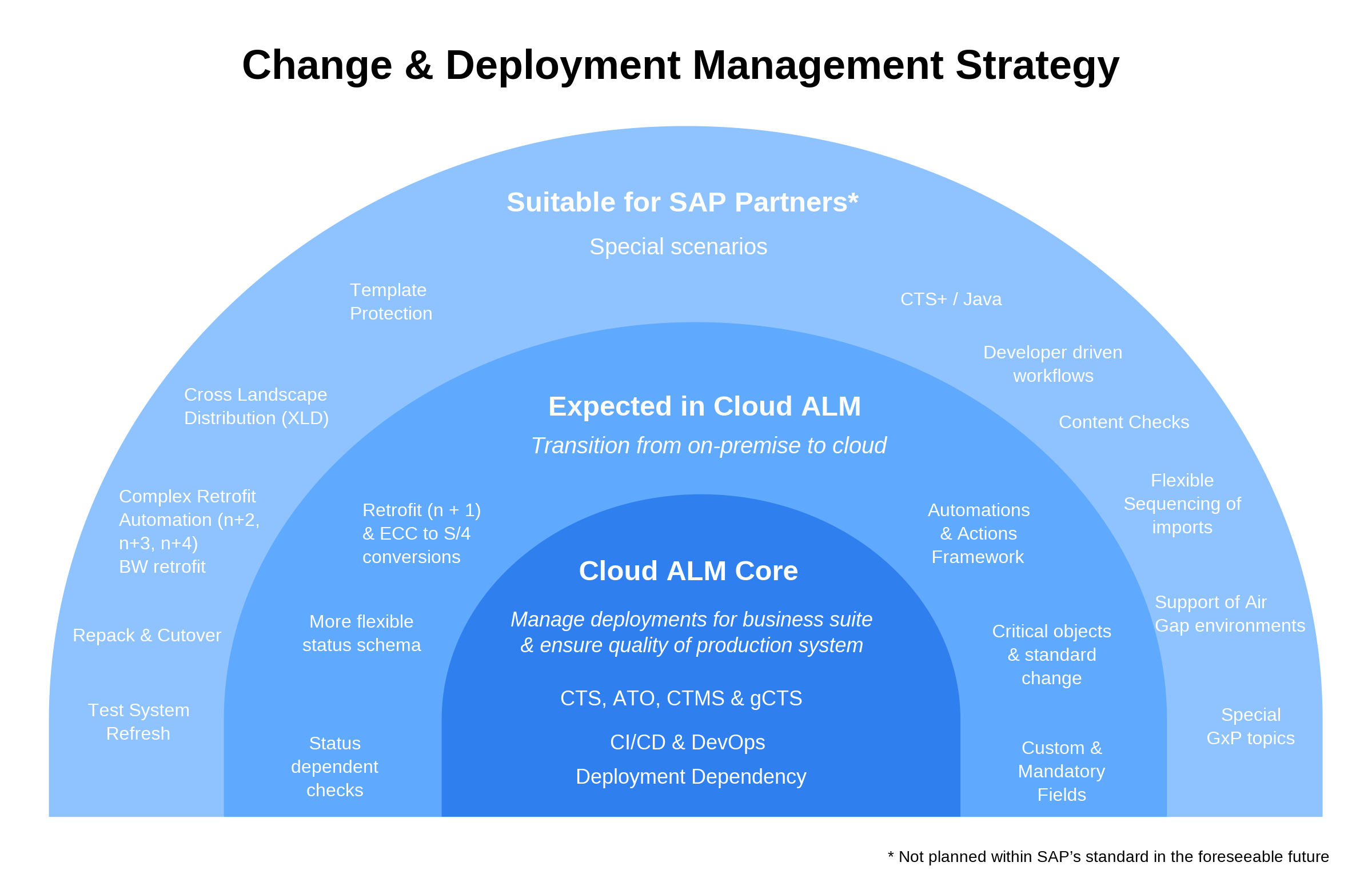
The ring of requirements sitting outside standard scope is well understood by anyone who has worked in a regulated SAP account: large-scale hybrid and on-premises operations, landscape automation and masked-data system refresh, complex retrofit beyond n+1, bespoke and validated change workflow, flexible import sequencing and dependency control, tight ITSM tool integration and non-SAP orchestration, air-gapped production runtimes, multi-tenant governance, and continuous audit evidence spanning both halves of the control environment at once.
For customers electing Cloud ALM as their center, this is what extends it into the estate they have now and during transition.
Two adjacent halves, one complete surface
What makes Avantra and Rev-Trac interesting together is the coverage of separate but related operational grounds. They are adjacent, and complementary solutions to two unique parts of compliant SAP operations.
Avantra governs the state of the systems: operating system, database, kernel, profile parameters, patch and SAP Note level, jobs, integrations, certificates, access and privilege, infrastructure security posture, consumption and cost, across on-premises, hyperscaler, Cloud ERP Private and BTP.
Rev-Trac governs change moving between them: ABAP objects, customizing, roles, and the request chain itself, including sequencing, dependencies, approvals, retrofit and delivery, across ECC, S/4HANA, Cloud ERP, BTP and non-SAP pipelines.
An auditor asks two questions: Is the system in a known, controlled state? Is every change to it authorized, tested and traceable?
Historically, customers have answered those two questions with two different toolsets, two different evidence formats, and a person in the middle reconciling them. The partnership answers both continuously, from one operating model, anywhere SAP runs.
Neither product on its own covers a serious audit of a complex estate. Both firms have concluded the same thing, and the outcome stands to be a significant benefit for complex SAP estates and customers.
Why compliance is the first focus
Compliance is where the combination is most obviously greater than the sum. In a regulated estate, evidence is currently a project: audit season arrives, and somebody reconstructs a control narrative from email, spreadsheets, ticket exports and the memory of whoever was on shift. This process is non-value-add activity at best and can be time-consuming and disruptive to production activities.
When state and change are both governed continuously, evidence stops being a project and becomes a by-product of doing the work. That is a categorical change in how a control environment operates, not an efficiency gain.
It scales, too. Multi-tenant control has long been the domain of service providers running many customers on one operating model. Today, it has arrived inside large enterprises treating multitenancy as a durable governance control point, with BTP and Cloud ERP Private becoming separately managed portions of the larger SAP estate.
What this series will cover
Over the pieces ahead, this series examines several common regulatory frameworks in turn and what it asks of SAP operations specifically:
- ISO 9001 – where the procedure is the control, and automation becomes the quality argument.
- GxP – where a validated state is a continuous claim, and validation must hold across on-premises and cloud systems simultaneously.
- ISO 27001 – where certification turns on demonstrated control operation, on any day of the cycle, across every part of the estate.
- SOX ITGC – where three control domains meet a landscape in motion, and external audit tests a population rather than a platform.
- DORA – where resilience is something you demonstrate, and a DR estate only counts if it matches.
- ITSM – the set of practices managing the execution of the other five and the service record that is only as trustworthy as the state and change data feeding it.
Each is unique in what it requires. All six share the same underlying demand: perfect traceability across the estate, its operations, and every change made to it.
The SAP customer is the winner here
Avantra and Rev-Trac are two firms with deep, specific expertise in SAP.
Avantra brings years of operations and automation depth in exactly the estates that don’t fit a standard mold. Rev-Trac brings one of the longest track records in governed SAP change anywhere in the market.
Between them, the complex regulated customer gets a single joint answer that works across the estate they have today and continues to work across the estate they are building.
For a customer facing a multi-year transition with a regulator waiting at every step, that is genuinely good news. In our next post, we explore ISO 9001 and maintaining continuous compliance with a focus on production process.